REGCA
Source: GridKit/Model/PhasorDynamics/Converter/REGCA/README.md
Renewable Energy Generator/Converter Model (REGCA)
REGCA is a first-generation WECC renewable generator/converter model for inverter-coupled resources. In GridKit it is represented as a controlled current source at the network interface.
Notes:
LVACM uses the unfiltered terminal voltage \(V_T\); LVPL uses the filtered voltage \(V_M\).
Internal currents are on converter base; bus injections are converted to system base in the network interface.
HVRCM is represented by internal algebraic current \(I_{\mathrm{q}}^{\mathrm{extra}}\).
Block Diagram
Standard REGCA converter-interface model.
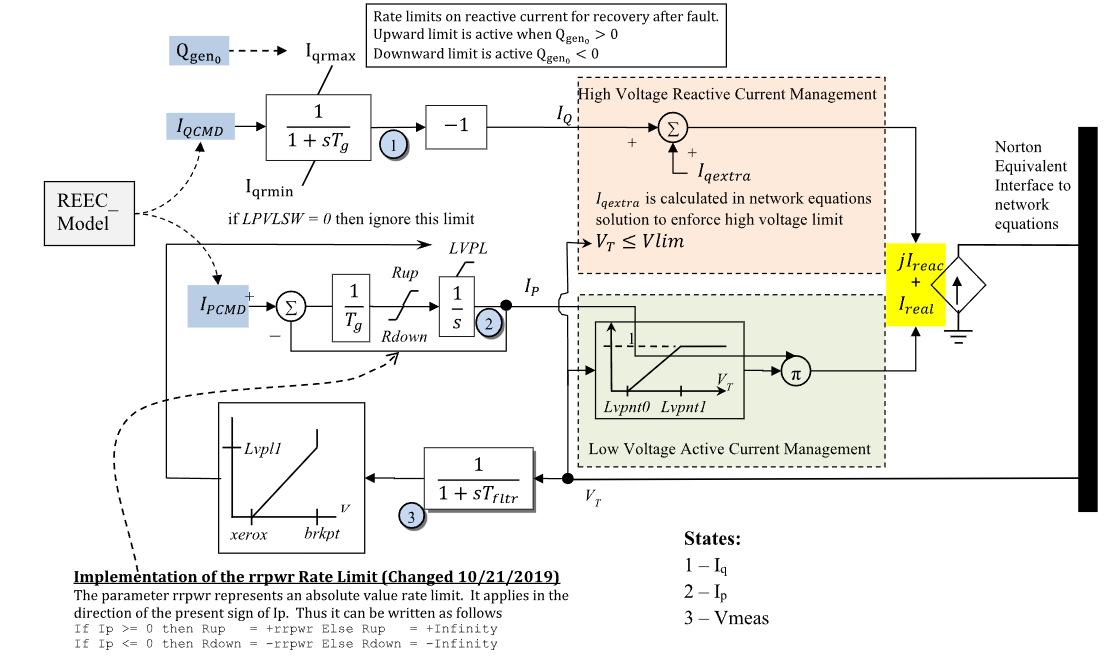
Figure 1: Generator/Converter REGCA model. Figure courtesy of PowerWorld
Model Parameters
Symbol |
Units |
Description |
Typical Value |
Note |
|---|---|---|---|---|
\(P_{\mathrm{0}}\) |
[p.u.] |
Initial active power injection |
On system base |
|
\(Q_{\mathrm{0}}\) |
[p.u.] |
Initial reactive power injection |
On system base |
|
\(S^{\mathrm{conv}}\) |
[MVA] |
Converter/model power base |
TBD |
|
\(T_{\mathrm{g}}\) |
[sec] |
Converter current-control lag time constant |
TBD |
|
\(T_M\) |
[sec] |
Terminal voltage sensor time constant |
TBD |
Block name: |
\(R_{\mathrm{q}}^{\max}\) |
[p.u./s] |
Reactive-current recovery positive rate limit |
TBD |
Block name: |
\(R_{\mathrm{q}}^{\min}\) |
[p.u./s] |
Reactive-current recovery negative rate limit |
TBD |
Block name: |
\(R_{\mathrm{p}}^{\max}\) |
[p.u./s] |
Active-current magnitude recovery rate limit |
TBD |
Block name: |
\(s_L\) |
[binary] |
LVPL switch |
TBD |
Block name: |
\(I_{L1}\) |
[p.u.] |
LVPL upper-current ceiling |
TBD |
Block name: |
\(V_{L0}\) |
[p.u.] |
LVPL zero-crossing voltage |
TBD |
Block name: |
\(V_{L1}\) |
[p.u.] |
LVPL upper breakpoint voltage |
TBD |
Block name: |
\(V_{A0}\) |
[p.u.] |
LVACM lower breakpoint voltage |
TBD |
Block name: |
\(V_{A1}\) |
[p.u.] |
LVACM upper breakpoint voltage |
TBD |
Block name: |
\(V_{\mathrm{hv}}^{\max}\) |
[p.u.] |
Terminal-voltage ceiling for HV reactive management |
TBD |
Block name: |
Parameter Validation
Implementations should reject or report invalid parameter sets:
Model Derived Parameters
The smooth active-current bound equations use \(M_{\mathrm{p}}\), a numerical relaxation for inactive \(\pm\infty\) rate bounds:
\(M_{\mathrm{p}}\) is not a physical REGCA parameter; it should be large enough that inactive bounds do not bind expected \(f_{\mathrm{p}}\) values while staying moderate enough to keep the smooth clamp well conditioned.
Model Variables
Internal Variables
Differential
Symbol |
Units |
Description |
Note |
|---|---|---|---|
\(V_M\) |
[p.u.] |
Filtered terminal voltage |
State 3 in Fig. 1 |
\(I_{\mathrm{q}}\) |
[p.u.] |
Reactive-current state |
State 1 in Fig. 1 before the |
\(I_{\mathrm{p}}\) |
[p.u.] |
Active-current state |
State 2 in Fig. 1; converter base |
Algebraic
Symbol |
Units |
Description |
Note |
|---|---|---|---|
\(V_T\) |
[p.u.] |
Terminal voltage magnitude |
|
\(I_{\mathrm{i}}\) |
[p.u.] |
Injected current, imaginary component on network reference frame |
Converter base |
\(I_{\mathrm{q}}^{\mathrm{extra}}\) |
[p.u.] |
Extra inductive current from high-voltage reactive current management |
Converter base |
\(I_L\) |
[p.u.] |
LVPL upper-limit current curve |
Function of \(V_M\) |
\(I_{\mathrm{r}}\) |
[p.u.] |
Injected current, real component on network reference frame |
Converter base |
\(\ell_{\mathrm{p}}\) |
[p.u./s] |
Smooth active-current lower rate bound |
Equivalent to diagram |
\(u_{\mathrm{p}}\) |
[p.u./s] |
Smooth active-current upper rate bound |
Effective |
External Variables
Differential
None.
Algebraic
Symbol |
Units |
Description |
Note |
|---|---|---|---|
\(V_{\mathrm{r}}\) |
[p.u.] |
Terminal voltage, real component on network reference frame |
Owned by bus object |
\(V_{\mathrm{i}}\) |
[p.u.] |
Terminal voltage, imaginary component on network reference frame |
Owned by bus object |
\(I_{\mathrm{q}}^{\mathrm{cmd}}\) |
[p.u.] |
Reactive-current command |
Converter base; owned by REEC, constant if no REEC is connected |
\(I_{\mathrm{p}}^{\mathrm{cmd}}\) |
[p.u.] |
Active-current command |
Converter base; owned by REEC, constant if no REEC is connected |
Model Equations
Define the pre-limit current derivatives:
Differential Equations
The exact state equations are
The implemented smooth state equations are
Here \(\rho\) is GridKit’s smooth ramp function. The \(I_{\mathrm{q}}\) branch is selected by initial reactive power \(Q_{\mathrm{0}}\). The \(I_{\mathrm{p}}\) equation is the smooth clamp of \(f_{\mathrm{p}}\) between the algebraic bounds \(\ell_{\mathrm{p}}\) and \(u_{\mathrm{p}}\).
Algebraic Equations
The piecewise definitions in this section switch on continuous states, unlike the \(I_{\mathrm{q}}\) differential branch selected by initial conditions. The exact algebraic targets are:
The implemented algebraic residuals use smooth \(\text{linseg}\), \(\rho\), and \(\sigma\) operators:
The \(V_T\) residual is kept in squared form for smoothness at the origin.
Network Interface
The bus receives system-base current injections converted from converter-base REGCA currents:
Positive current injection is into the bus.
Initialization
Given initialized bus voltage \(V_{\mathrm{r}}, V_{\mathrm{i}}\), compute the steady-state initial values:
For normal power-flow starts, \(V_T > V_{A1}\), so \(\text{linseg}(V_T;\ V_{A0},\ V_{A1},\ 1) = 1\) and the \(I_{\mathrm{p0}}\) formula is well defined.
Initialization should verify:
\(V_T \le V_{\mathrm{hv}}^{\max}\). If \(V_T \ge V_{\mathrm{hv}}^{\max}\), \(I_{\mathrm{q0}}^{\mathrm{extra}} = 0\) may not satisfy the HVRCM algebraic condition, and a nonzero value should be solved or the initialization rejected.
\(\text{linseg}(V_T;\ V_{A0},\ V_{A1},\ 1) > 0\) when \(I_{\mathrm{r0}} \ne 0\). If the LVACM gain is zero, no finite \(I_{\mathrm{p0}}\) can reproduce nonzero initial active current.
All internal derivatives initialize to zero.
Model Outputs
Real and imaginary injected currents, \(I_{\mathrm{r}}\) and \(I_{\mathrm{i}}\), are converter-base algebraic variables. System-base power outputs use the bus-facing currents:
Power outputs are positive leaving the converter and entering the bus.