Bus
A bus is a point of interconnection of electrical devices. The bus component model also plays a key role in coupling system components. Each bus \(k\) owns two variables: real voltage and imaginary voltage, denoted as \(V_{rk}\) and \(V_{ik}\), respectively. The bus also owns current-balance residual equations for real and imaginary currents entering the bus, denoted as \(I_{rk}\) and \(I_{ik}\), respectively. While the bus model owns current residuals, it does not compute them. Instead, each component connected to the bus adds its contribution to the residual. The bus initializes the residual to zero each time the numerical integrator requests residual evaluation.
Sign Convention
Current entering the bus has positive sign, and current exiting the bus has negative sign.
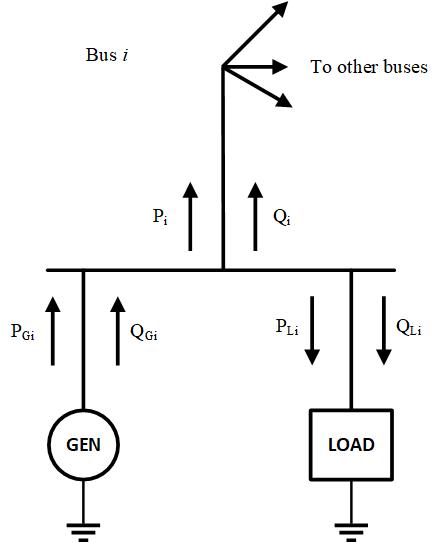
Figure 1: Bus-variable diagram. This should be updated to represent current balance instead of power balance.
Model Parameters
Buses are uniquely identified by their numeric bus ID. Each bus has an associated nominal voltage.
Symbol |
Units |
JSON |
Description |
|---|---|---|---|
\(V_\mathrm{base}\) |
[kV] |
|
Nominal bus voltage |